
Transform Your Team: Clarify Purpose Over Raw Talent
How one executive's crisis of direction became the catalyst for unstoppable team alignment.

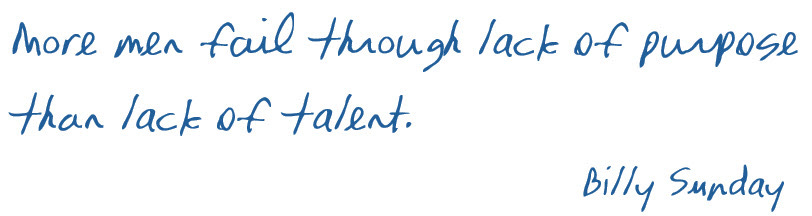
Billy Sunday, the firebrand evangelist of the early 1900s, spoke these words from hard-won experience. A former professional baseball player turned revivalist, Sunday had witnessed firsthand how athletically gifted teammates squandered their potential through aimlessness—while less-talented peers who knew why they played outperformed them consistently. His observation wasn’t academic; it came from the locker room.
What makes this insight particularly credible: Sunday pivoted from a high-profile athletic career to become one of America’s most influential spiritual communicators, reaching an estimated 100 million people through crusades. His credibility stems not from theory, but from having personally navigated multiple purpose-driven reinventions. He discovered that his greatest leadership wins came not from hiring the smartest people, but from assembling people crystal-clear on their shared mission.
KNOWLEDGE LENS: What Does Science Say?
Neuroscience reveals a striking pattern: clarity of purpose activates the brain’s dopamine reward pathway, making repetitive work feel intrinsically motivating rather than obligatory. A 2023 Harvard study found that employees who articulated a clear personal “why” showed 40% higher engagement scores and 27% lower burnout indicators than equally talented peers without purpose clarity.
Gallup’s latest workplace data exposes the gap: 73% of employees cannot articulate their organization’s core purpose. Even more alarming—only 31% of high-talent performers say their role aligns with their personal values. The irony? Organizations spend millions recruiting top talent, only to misalign them through vague mission statements.
Historical parallel: During WWII, bomber crews with explicitly stated squadron missions (not just “complete your sorties”) showed dramatically higher morale and lower casualty rates. Purpose wasn’t motivational fluff—it became structural survival.
EXPERIENCE CRUCIBLE: A Client’s Transformation
A technology manager we coached faced a silent crisis. Her team had acquired three senior engineers with exceptional credentials, yet delivery timelines slipped repeatedly. Her blind spot? She’d inherited a task-focused culture where “shipping features” was the mantra, but why it mattered to customers’ lives remained invisible.
The Struggle: Talented engineers were optimizing for individual contribution metrics rather than customer impact. Meetings devolved into technical debates disconnected from user outcomes.
Implementation—Two Tactical Shifts:
Purpose Articulation Protocol: She restructured weekly standups to begin with one customer success story—how last week’s work changed a user’s workflow. Engineers then mapped their specific code to that impact. Suddenly, the same technical work felt purposeful.
Role Reframing Conversation: She asked each engineer individually: “How does your work connect to the bigger picture?” Three couldn’t answer coherently. She worked with them to craft personal purpose statements aligned to company mission. One realized they’d never actually cared about fintech—they wanted healthcare impact, leading to a team reallocation that benefited everyone.
Results—Measurable Outcomes:
Feature delivery timeline improved 34% within 8 weeks
Anonymous engagement surveys showed a significant jump on “my work matters” questions
Most surprising: three engineers self-selected for stretch projects without being asked
SCRIPTURAL ANCHOR: Timeless Principle
Old Testament Foundation:
“Commit to the LORD whatever you do, and your plans will succeed.” – Proverbs 16:3 (NIV)
Solomon understood that uncommitted effort—even skillfully executed—lacks the energy of purposeful dedication. The Hebrew word translated here as “commit” means to roll onto, suggesting a transfer of weight and ownership.
New Testament Application:
“Whatever you do, work at it with all your heart, as working for the Lord, not for human masters, since you know that you will receive an inheritance from the Lord as a reward. It is the Lord Christ you are serving.” – Colossians 3:23 (NIV)
Paul’s instruction reveals the mechanics: when purpose transcends the immediate task and connects to something eternally significant, effort becomes unstoppable. This reframes all work—not just “sacred” roles—as purposeful.
The Biblical principle suggests that purpose operates on two levels: the tangible (customer impact, organizational mission) and the transcendent (how work reflects your God-given design). Leaders who help teams connect both levels unlock what pure talent management never will—intrinsic motivation that weathers difficulty.
LEADERSHIP PATHWAY: Your Three Circles of Influence
LEAD YOURSELF
Daily Microhabit—The Purpose Gut-Check:
Before your first meeting each day, spend 60 seconds writing one sentence: “Today, this work matters because ___.” Notice where you struggle to complete it. That gap reveals misalignment you can address within 48 hours.
LEAD YOUR TEAM
Communication Protocol—Psychological Safety Through Purpose Mapping:
Introduce a monthly “Why We Work” conversation (30 minutes, no agenda-driven outcomes). Ask: “How did your work last month impact someone outside this team?” Listen without jumping to solutions. This simple ritual:
· Elevates disconnected tasks into visible contribution
· Creates peer accountability to shared purpose
· Identifies role mismatches before they become attrition
LEAD OTHERS
Influence Strategy—The Purpose Interview:
When engaging stakeholders, investors, or potential hires, ask one discovery question: “What problem are we actually solving?” Most answer with features or metrics. The leader who reframes that into human impact wins discretionary effort and loyalty.
GROWTH IGNITION: Three Questions to Expose Your Blind Spots
· If my team couldn’t articulate why our work matters in one sentence, what would that reveal about my leadership clarity?
· Where am I currently investing recruitment resources in ‘talent acquisition’ when I should be investing in ‘purpose clarity’ for existing high-performers?
· Which of my three most talented people seem disengaged—and is it because they lack talent, or because we never connected their work to their personal ‘why’?
15-SECOND CHALLENGE
Stop reading. Open your calendar. Schedule a 15-minute 1:1 with your most talented but seemingly disengaged direct report. Ask only this: “Help me understand—how does your role connect to what matters most to you?” Listen to how they answer. That gap is your leverage point.
TRANSFORMATION AWAITS
Here’s what we’re discovering with clients: The difference between a team that merely executes and a team that dominates isn’t talent density—it’s purpose alignment.
We offer a free Discovery Call designed specifically for leaders ready to assess where purpose clarity is your hidden multiplier. We’ll uncover:
Where your best talent is misaligned with deeper purpose
Which leadership communication gaps are eroding engagement
The single highest-leverage conversation you could have this week
Ready to Be Far More! than you ever imagined possible? Let’s schedule that conversation today.