
0359 | Transform Your Scars Into Signposts of Strength
The leadership journey from survival mode to a life that leaves smiling marks on everyone you lead.

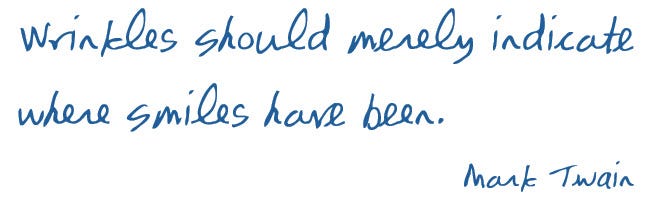
Mark Twain wrote some of his most luminous words from inside his deepest darkness. By 1894, Samuel Langhorne Clemens — the man who made the world laugh — faced complete financial ruin from a catastrophic investment in a failed typesetting machine. Then came a blow no balance sheet could measure: the death of his beloved eldest daughter, Susy, from meningitis in 1896. His wife Olivia’s health began a long and painful decline soon after. The man who turned the Mississippi River into literature was drowning.
Yet — and here is the surprising biographical detail that sharpens this wisdom to a point — it was precisely during this catastrophic season that Twain embarked on a grueling around-the-world lecture tour and produced some of his most compassionate reflections on the human condition. He didn’t just survive suffering; he refused to let suffering write the final chapter of his character. When Twain wrote that wrinkles should only record where smiles have been, he wasn’t offering a greeting-card platitude. He was issuing a hard-won leadership manifesto: the texture of your life, including every crease of difficulty, should be evidence of joyful, generous, fully-engaged living — not a map of bitterness, regret, and withdrawal.
For leaders today, the question isn’t whether the hard seasons will come. They will. The real question is: What story will your face — and your leadership — tell when they do?
Filter #1: Knowledge — What Science Confirms
Two Findings That Will Change How You Lead Yourself
Finding One: Your brain is wired to record negativity — but you can rewire it.
Neuroscience has confirmed what great leaders have intuitively known for centuries: the human brain possesses a negativity bias, encoding negative experiences up to three times more rapidly than positive ones. However, research on neuroplasticity — the brain’s lifelong capacity to reorganize itself by forming new neural connections — establishes that consistent, deliberate practices of positive thinking can literally restructure the brain’s architecture, shifting leaders away from threat-dominated reactive states toward innovation-generating, relationally open ones. Neuroplasticity enables the brain to cultivate optimism by transforming entrenched negative thought patterns into positive, forward-looking frameworks.
Finding Two: Leader positivity is contagious — and the data proves it.
Harvard Business Review research confirms that leaders who express positivity early in relationships and team formation drive measurably better employee performance. Meanwhile, University of Phoenix research establishes that optimism is literally contagious in team settings — when leaders model a joyful, resilient orientation, it spreads to those they lead (May, 2023).
The Workplace Gap This Exposes:
Gallup’s State of the Global Workplace 2026 Report delivers a sobering reality check: global employee engagement crashed to just 20% in 2025 — its lowest level since 2020 — costing the global economy an estimated $10 trillion in lost productivity. Stress, anger, and sadness among workers remain above pre-pandemic levels. The gap between what joyful, optimistic leadership could produce and what cynical, disengaged leadership is producing is worth ten trillion dollars. That is the leadership opportunity hidden inside Twain’s 12-word sentence.
Historical Parallel: The Roman Stoics understood this 2,000 years before neuroscience confirmed it. Marcus Aurelius — emperor, general, and philosopher — wrote his Meditations not as a published treatise but as a private discipline of daily positivity reframing. He governed an empire by governing his own mind first.
Filter #2: Experience — A Real Transformation Arc
From Survival Mode to Signpost Leader
Coaching Conversation #1
“I feel like I’m just grinding through every day. I keep waiting to feel motivated again before I start leading differently.”
“That’s the trap. You’re waiting for the emotion to precede the action. What if you reversed the sequence — acted joyfully, purposefully, generously — and let the emotion follow the behavior?”
Here is a composite story drawn from real coaching work (details altered to protect privacy):
A mid-level operations leader came into coaching visibly worn down. Years of organizational restructuring, two rounds of layoffs she had to announce, and the weight of a team that watched her face for cues every single morning had produced a critical blind spot: she had unconsciously adopted a “serious means credible” leadership posture. She stopped smiling in meetings. She stopped acknowledging wins before pivoting to problems. She framed every team update around what was still broken. Her team — already stressed — began mirroring her energy. Voluntary engagement scores dropped. Two of her strongest performers requested transfers.
Two Tactical Changes Implemented Over 90 Days:
The “One Win First” Protocol: Every team meeting, no exceptions, opened with a two-minute celebration of one specific team or individual win from the previous week. Not a manufactured cheerleading exercise — a specific, named, documented acknowledgment tied to real results.
The “What’s Working?” Weekly Reflection: Every Friday, she sent a brief personal message to each direct report noting one thing she observed them doing well. No performance agenda attached. Just genuine, specific, timely recognition.
Coaching Conversation #2
“My team seems suspicious of the positive shift. They think something is wrong.”
“Of course they do — you changed the pattern. Name it directly: ‘I’ve realized I’ve been leading from my stress instead of my strength. I’m choosing differently. Stay with me.’ Transparency disarms suspicion every time.”
Measurable Results at 90 Days:
Team engagement score increased from the 34th percentile to the 61st percentile
Zero additional transfer requests
One of the two previously departing performers asked to lead a new cross-functional initiative
Coaching Conversation #3
“I didn’t realize how much my face was costing the team. I thought I was being realistic.”
“You were being accurate — but not complete. Reality includes what’s working, what’s possible, and who your people are becoming. Lead from the full picture.”
Twain would recognize this leader’s journey. He, too, discovered that choosing joy — not as a denial of hardship, but as a declaration of what matters most — was itself a form of courageous, other-focused leadership.
Filter #3: Scriptural Anchor — What the Bible Says
The Timeless Truth of the Joyful Leader
Old Testament — Proverbs 17:22 (NIV): “A cheerful heart is good medicine, but a crushed spirit dries up the bones.”
Three thousand years before Gallup measured disengagement, Solomon identified the precise mechanism: a leader’s interior orientation — cheerful or crushed — functions as medicine or poison to the entire organizational body. The word translated “cheerful” carries the Hebrew sense of a radiant, joyful brightness that emanates outward. Solomon was not describing a personality type. He was describing a leadership discipline.
Consider the contrast between King Saul — who allowed a crushed spirit to hollow him from the inside, paralyzing his army and ultimately destroying his reign — and David, who, even in caves and deserts, returned repeatedly to joy as his anchor. Psalm 16, Psalm 23, Psalm 34 — David’s journals are not a record of problem-free leadership. They are a record of joy chosen amid chaos.
New Testament — Philippians 4:4 (NIV): “Rejoice in the Lord always. I will say it again: Rejoice!”
Paul wrote these words from a Roman prison cell — not a leadership retreat. The repetition (”I will say it again”) is not rhetorical flourish; it is a coach’s command, recognizing that the human tendency is to rejoice sometimes, conditionally, when circumstances permit. Paul rejects that framework entirely. The joy he commands is not dependent on outcomes — it is rooted in identity and relationship with God. For leaders, this distinction is transformative: joy anchored in who you are and Whose you are cannot be taken by quarterly results, personnel challenges, or organizational turbulence.
Together, these passages confirm what Twain’s wit captured in twelve words: a life and leadership marked by genuine, sustained joy — even through difficulty — is not naive optimism. It is the most powerful and durable force available to any leader.
Leadership Pathway: Lead Yourself → Your Team → Others
Lead Yourself: The Daily Microhabit
The “Three Smiles Audit” — Every Morning Before You Lead Anyone Else
Before you open your first email or enter your first meeting, spend 90 seconds completing this three-part microhabit:
Recall one moment from the past 24 hours that genuinely made you smile. Name it specifically — not vaguely.
Identify one person on your team you are genuinely grateful for today. Decide how you will show it before noon.
Name one thing about your work today that you are energized by — not obligated to, but genuinely energized by.
This practice rewires the negativity bias by deliberately activating the brain’s reward circuitry before the noise of the day floods your prefrontal cortex. You cannot lead others from joy you have not first cultivated in yourself.
Lead Your Team: Communication Technique for Psychological Safety
The “Story Behind the Smile” Check-In
Once per week — in a team meeting or 1:1 — replace the standard “How are things going?” opener with this prompt:
“Tell me about something that genuinely energized you this week — at work or outside it.”
This single, low-cost conversational shift accomplishes three things:
It signals that you see the whole person, not just the productivity unit
It generates positive emotional data that the brain stores and associates with you as a leader
It creates space for authentic human connection — the foundational building block of psychological safety
Teams with high psychological safety outperform peers by significant margins on innovation and retention metrics.
Lead Others: Influence Strategy for External Stakeholders
The “Marked by Smiles” Presence Protocol
When engaging clients, prospects, board members, or community partners, operate by this principle: every person who encounters you should leave the interaction energized, not drained.
Before each external interaction, ask yourself: “What is one specific thing I can affirm, celebrate, or encourage about this person or their work today?” Deploy it early in the conversation. People do not forget how you made them feel. Your influence expands or contracts based on the emotional residue you leave behind.
Twain’s wrinkles were not marks of age — they were the visible record of a man who chose, again and again, to engage his world with humor, warmth, and humanity. That legacy still influences millions of readers today. Your smile — your consistent, leader-grade joy — is your longest-lasting influence strategy.
Growth Ignition
Three Probing Questions to Expose Rationalization vs. Real Barriers
“I would lead more joyfully if only ______ would change first.”
Fill in that blank honestly — then ask yourself: Is that a real barrier, or is it a permission slip I’ve issued myself to delay becoming who I’m capable of being? Joy is not the reward at the end of the hard season. It is the fuel that gets you through it.When was the last time someone on your team — or in your life — specifically mentioned your joy as something that positively impacted them?
If you struggle to remember, that data point deserves your full attention. What have you been radiating instead?If your leadership style were described by the “wrinkles” you are currently leaving on your team — what would those wrinkles indicate?
Stress? Pressure? Anxiety? Or engagement, possibility, and the contagious belief that the best is ahead? The answer reveals where your next growth edge lives.
The 15-Second Challenge
Right now — before you close this article, before you move to your next task — send one text or write one handwritten note to someone in your sphere of influence that says:
“I was thinking about you today. I’m grateful for [one specific thing] about you. Keep going.”
That’s it. Fifteen seconds. One deliberate act of joy-based leadership. Start the habit right now, in this moment.
Your Next Step: The Free Discovery Audit
Twain’s smiles — chosen through bankruptcy, loss, and grief — were not accidental. They were the fruit of a man who had decided, at his core, what kind of leader he would be regardless of circumstances.
You get to make that same decision.
I invite you to schedule your complimentary Leadership Discovery Audit. In this focused conversation, we will identify the specific leadership leverage points where your greatest growth — and greatest impact — awaits. We will examine where your joy is robust, where it has been quietly eroding, and what one or two intentional shifts could unlock an entirely new level of influence for you, your team, and the people you serve.
The wrinkles you are earning right now are being written. Let’s make sure they tell the right story.