
Transform Frustration Into Innovation Today
From gridlock to breakthrough: Unlock extraordinary potential by working with what's already in your hands.

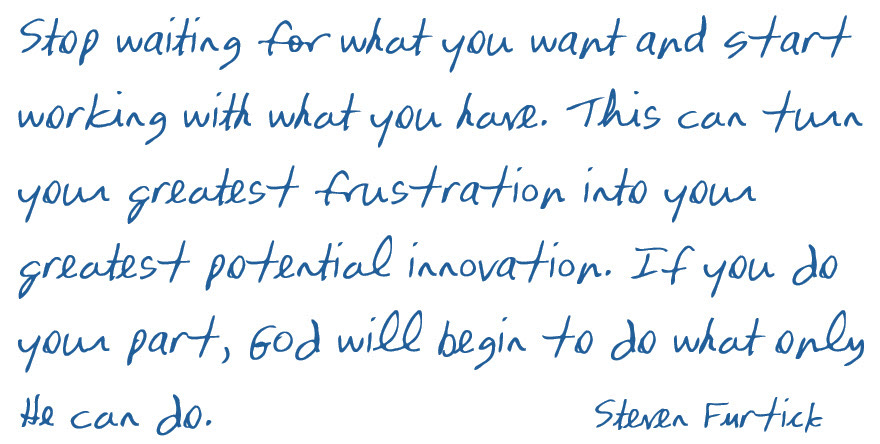
Steven Furtick arrived at this wisdom during a season when everything he built seemed to crumble. A pivotal moment came when he realized he’d been waiting for perfect circumstances — the right platform, the right resources, the right timing — before taking bold action. That taught him that God doesn’t wait for our comfort; He works through our constraints. What makes this insight credible isn’t just Furtick’s spiritual leadership of a multi-campus church reaching over 30,000 weekly attendees, but his background as someone who started with virtually nothing and built something extraordinary by working relentlessly with what he had. He embodies the principle he teaches: your scarcity often becomes your superpower.
KNOWLEDGE LENS: What Science Reveals
Neuroscience confirms that constraint breeds creativity. Research from Northwestern University found that when our brains face limitations, we activate the anterior cingulate cortex—the region responsible for creative problem-solving. Rather than paralyzing us, scarcity forces our minds to make novel connections we’d miss in abundance.
Additionally, organizational psychologist Adam Grant’s research shows that waiting for perfect conditions creates “activation paralysis.” Teams stuck in perpetual planning mode experience 34% lower engagement than those who iterate with imperfect resources. Gallup data reinforces this: 60% of leaders struggle with decision fatigue because they’re waiting for complete information rather than acting on sufficient insight. The cost? Missed market windows, demoralized teams, and organizational drift.
Historical parallel: During WWII, British engineers innovated radar systems under severe material constraints — limitations that actually accelerated breakthroughs because they eliminated unnecessary complexity.
EXPERIENCE CRUCIBLE: Client Transformation
I coached a nonprofit director drowning in what I call “the comparison trap.” She’d been waiting for grant funding to expand programming before implementing her vision. Her blind spot? She believed resources precede action. Her team felt stuck — watching the executive delay decisions until the mythical “right moment.”
The shift happened through two tactical changes:
First, we conducted a 48-hour “asset audit” — cataloging what she already possessed: volunteer networks, partnerships, digital tools, and community relationships. We discovered she had 60% of what she needed already present.
Second, we implemented “iteration sprints” — small 2-week cycles testing ideas with existing resources, then measuring results. Instead of planning a $50,000 program overhaul, she piloted a micro-version with $2,000 and her team’s sweat equity.
The results? Remarkable. Her team’s initiative jumped from “waiting mode” to “testing mode.” Three months later, that grant she’d been chasing? It came — but this time, her application showcased already-proven results. The real breakthrough: her mindset shifted from “I need resources to lead” to “I lead with what I have, and resources follow.”
SCRIPTURAL ANCHOR: Ancient Wisdom, Modern Application
The principle weaves through Scripture like a golden thread:
Old Testament wisdom shows us in Proverbs 22:29—”Do you see someone skilled in their work? They will serve before kings” — that excellence with available tools, not waiting for ideal circumstances, positions you for influence.
New Testament urgency appears in Matthew 25:14-30, the Parable of the Talents. The servants rewarded weren’t those with the most resources; they were those who multiplied what was entrusted to them. The condemned servant? He buried his talent, waiting for… what? A better opportunity? More guidance?
The Biblical context deepens the principle: God’s pattern throughout Scripture is partnership — you do your part, I do mine. The widow at Zarephath had flour and oil for one meal; Elijah worked with that constraint, and the supply never ran dry (1 Kings 17:12-16). Limitation wasn’t a hindrance; it was the crucible for miracles.
Modern application: Stop treating constraints as God’s “no.” They’re often His invitation to collaborate.
LEADERSHIP PATHWAY: Lead Yourself → Your Team → Others
SELF: Daily Microhabit
Each morning, write three things you have access to today (skills, relationships, tools) that you’ve been underutilizing. Then execute one action using only those assets — no waiting, no “if only.” This rewires your brain from scarcity thinking to agency thinking.
TEAM: Communication Protocol
Implement “Capability Conversations” — weekly 15-minute huddles where team members surface what resources, ideas, or connections they already possess that haven’t been deployed. Psychological safety flourishes when people feel trusted to solve problems within their reach rather than waiting for executive permission.
OTHERS: Influence Strategy
When speaking with stakeholders, lead with early wins. Show what you’ve achieved with current resources. This builds credibility and magnetizes additional support. External partners invest in proven momentum, not potential promises.
GROWTH IGNITION: Your Breakthrough Awaits
Three Probing Questions (Expose the Real Barrier):
What specific resource are you waiting for before taking your next leadership step? (Now ask: What’s one micro-version of that initiative you could launch this week without it?)
When you imagine working with what you have right now, what emotion surfaces first — excitement or anxiety? (Your answer reveals whether this is a resource problem or a belief problem.)
Who on your team or network has repeatedly impressed you by innovating under constraints? What would change if you named that as their superpower instead of their limitation?
15-SECOND CHALLENGE
Stop reading. Identify one thing you’ve been waiting for before moving forward on an important goal. Now, write down three things you already have that could move the needle toward that goal, even 1% this week. Pick one. Do it by tomorrow at 5 PM. Your future self will thank you.
YOUR NEXT STEP
Here’s what I’ve observed: Leaders often aren’t lacking resources — they’re lacking permission to begin. That’s exactly what a complimentary Discovery Call addresses. In a 30-minute conversation, we’ll map your specific leadership leverage points and identify where you’re sitting on untapped potential.
The question isn’t What do I need? It’s What will I do with what I already have?
The Trajectory Shift
What 1° trajectory shift could this wisdom create if applied within 48 hours?
P.S. In my experience, the leaders who’ve achieved the most didn’t wait for perfect conditions. They worked with what they had, learned rapidly, and let results attract resources. Which category will you choose?