
Time as Currency, Not Commodity
From "I'm too busy" to "I'll make time"—the mindset shift that multiplies your influence.

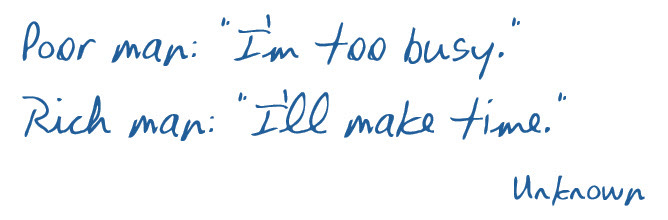
This saying emerged from observing a fundamental paradox: people with the least time often claim to have none, while those building empires fiercely protect it. The wisdom crystallizes around a crucible moment we’ve all experienced — that exhausting season when busyness becomes your identity rather than your circumstance.
Here’s the surprising biographical insight: this phrase gained traction not from ivory tower academia, but from street-level entrepreneurs and coaches who noticed a pattern. The wealthy didn’t have more hours in their day; they possessed a different relationship with those hours. They viewed time as their most appreciating asset, not a fixed commodity to be spent reactively. This mindset distinction separates those who build legacies from those who merely survive schedules. The poor man defaults to scarcity thinking (”I don’t have time”). The rich man operates from abundance strategy (”I choose where my time flows”).
Knowledge Lens: What Science Reveals
Your brain processes time through two competing neural pathways. Research from Stanford’s behavioral economics lab shows that scarcity mindset (the “too busy” orientation) triggers your amygdala, creating decision fatigue that collapses your executive function by 40%. When you feel time-starved, you default to reactive survival mode — exactly backward from where growth lives.
Conversely, abundance-oriented time thinking activates your prefrontal cortex — the region governing strategic planning and delayed gratification. A Gallup 2024 study found that leaders who protect time intentionally (the “I’ll make time” posture) report 63% higher engagement in their teams and 2.8x better decision quality.
Historical parallel: Benjamin Franklin famously tracked every 15 minutes of his day — not from obsession, but from a conviction that time observed becomes time optimized. His competitors called it tedious; his legacy called it mastery.
Experience Crucible: The Transformation Blueprint
A regional sales director came to me drowning. She managed five team members, juggled three corporate initiatives, and felt perpetually behind. In our first session, she said: “Richard, I’m doing the work of seven people. I’m exhausted.” Her blind spot? She confused being busy with being productive. Every interruption felt urgent. Every email demanded immediate response. Her calendar owned her.
Implementation—Two Tactical Shifts:
Time Ownership Protocol: We implemented “time blocking” — but not the typical kind. She designated 90-minute “focus windows” where only her highest-leverage activities existed. Everything else went to a “batch processing” window twice daily. Within week two, she noticed her energy shifted from reactive to intentional.
The “No” Architecture: We crafted a simple decision filter: “Does this align with my team’s growth or my strategic priority? If no, I delegate or decline.” She literally said “no” to three recurring meetings that consumed 4 hours weekly. Her team actually performed better without her in the room—they owned the decisions.
Results After 90 Days:
Her one-on-one coaching depth improved dramatically (she was actually present)
She reclaimed 8 hours weekly for strategic thinking
Most tellingly: she stopped saying “I’m too busy” and started saying “Let me make time for that”—a subtle language shift reflecting a profound mindset reset
The pivot? She moved from time management (a poverty mindset — squeezing scarcity) to time leadership (a wealth mindset — stewarding abundance).
Scriptural Anchor: Ancient Wisdom, Modern Application
Old Testament - Ecclesiastes 3:1 (NIV): “There is a time for everything, and a season for every activity under the heavens.”
This passage isn’t poetry about passivity — it’s architecture. Solomon isn’t saying “accept whatever comes”; he’s saying recognize the season you’re in and steward it intentionally. The rich person distinguishes seasons. The poor person treats all moments as emergency.
New Testament - Ephesians 5:15-16 (NIV): “Be very careful, then, how you live—not as unwise but as wise, making the most of every opportunity, because the days are evil.”
Paul’s word “making the most” (Greek: exagorazō) literally means “buying back” — as if redeeming something previously lost. This is active reclamation, not passive acceptance. You make time; you don’t find it.
Biblical stewardship assumes you’re not a victim of your calendar — you’re a curator of it. God gave you dominion over time just as He gave dominion over creation. The poor mindset says, “Life happened to my schedule.” The rich mindset says, “I’m stewarding my hours like the treasure they are.”
Leadership Pathway: Lead Yourself → Your Team → Others
Lead Yourself: Your Daily Microhabit
The 5-Minute Time Audit (do this tomorrow morning): Before checking email or messages, ask yourself: “What’s the ONE activity today that compounds my leadership?” Write it down. Block 90 minutes for it before noon. Everything else is negotiable.
This single habit rewires your brain from reactive to intentional—the exact shift that separates the busy from the rich in time currency.
Lead Your Team: Communication Protocol for Psychological Safety
The “Batch Communication” Agreement:
Hold a 15-minute team conversation this week: “I want to be more present with you, so I’m changing how I’m available. I’m checking messages at 10am, 2pm, and 4pm — not constantly. This means you get my full attention in our time together, not divided focus.”
This isn’t withdrawal; it’s presence. When your team sees you protecting focus time, they stop viewing interruptions as normal and start protecting theirs. Psychological safety grows when leaders model that deep work matters.
Lead Others: Your Influence Strategy for External Stakeholders
The “Calendar as Credibility” Move: When external partners request your time, respond with: “I protect focused time for strategic work. Here are three specific windows this week I can give you my undivided attention.”
This sounds like scarcity but reads as abundance. You’re signaling: “My time is valuable, and I steward it carefully — which means when you get me, you get excellence.” Rich people understand that scarcity of availability paradoxically increases perceived value.
Growth Ignition: Three Questions + One Challenge
Where am I confusing activity with impact? (What meetings do I attend that someone else could own? What emails do I answer that don’t require my thinking?)
What’s the real fear behind “I’m too busy”? (Is it actually: I’m afraid if I stop moving, I’ll confront something I’m avoiding? I’m afraid my value equals my busyness?)
If I reclaimed just 5 hours this week, what ONE conversation or strategic thinking would I protect? (Don’t say “rest”—be specific. What leadership leverage point are you currently neglecting?)
The 15-Second Challenge
Right after you finish reading this: Close your email. Open your calendar for next week. Block ONE 90-minute window labeled “Strategic Focus Time—Do Not Interrupt.”
That’s it. One block. That’s the wedge that starts shifting your entire relationship with time.
Here’s what I’ve learned from working with leaders across many industries: The gap between “I’m too busy” and “I’ll make time” isn’t about finding hours — it’s about clarity on what actually matters.
Many leaders I work with hit a ceiling not because they’re lazy, but because they’ve never audited their time architecture. They inherited their calendars rather than designed them.
Ready to shift from “too busy” to “I’ll make time”? That’s exactly what a Discovery Call addresses.
In a complimentary 30-minute session, we’ll examine:
Where you’re experiencing the most friction between intention and reality
Your specific leadership blind spots around time stewardship
One immediate leverage point that could reshape your next 90 days
This isn’t coaching-lite. This is diagnosis—the clarity that precedes transformation.
You don’t need a complete calendar redesign. You need one small decision made differently. One meeting declined. One focus window protected. One conversation with your team about what “available” actually means.
That 1° shift, compounded over 90 days? That’s the difference between another year of busyness and your first year of real leadership leverage.
The choice is yours. The time? You already have it.
Such a great reframe.