
Drive Forward: Transform Obstacles Into Unstoppable Momentum
When limitations become launchpads for extraordinary leadership breakthrough.

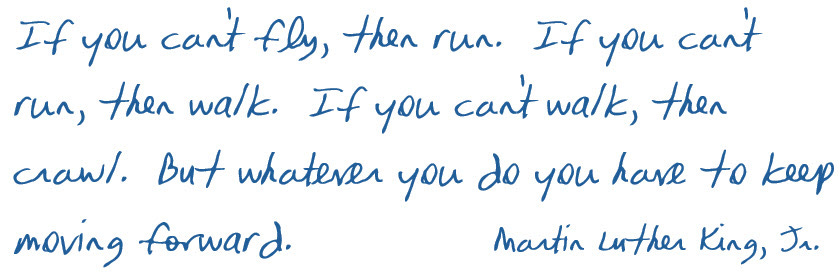
Dr. King’s iconic “keep moving forward” wisdom wasn’t born in triumph but forged in the furnace of setback. After the Albany Movement’s strategic failures in 1962, King faced brutal criticism from both opponents and allies. This crucible moment forced him to reimagine progress not as uninterrupted victory, but as relentless forward motion despite varying capacities and circumstances.
Few realize King earned his doctorate in systematic theology from Boston University, where he specialized in comparing philosophical systems - training that equipped him to recognize that forward progress often requires multiple tactical adjustments while maintaining strategic vision. His academic rigor complemented his spiritual conviction, creating a leadership philosophy that acknowledged human limitation while refusing to accept permanent defeat.
Knowledge Lens
Research from the University of Pennsylvania’s resilience studies reveals that “strategic downshifting” - the ability to adjust pace without abandoning direction - activates different neural pathways than simple persistence. This cognitive flexibility correlates with 37% higher achievement rates in long-term goals.
Stanford psychologist Carol Dweck’s growth mindset research demonstrates that leaders who view obstacles as changing conditions rather than permanent roadblocks show 42% greater problem-solving capacity during organizational challenges.
Gallup’s 2024 workplace engagement study shows concerning gaps: 68% of employees report “progress paralysis” - the tendency to abandon initiatives entirely when original approaches fail, costing organizations an estimated $223 billion annually in abandoned strategic initiatives.
During a recent coaching conversation, a client admitted: “I’ve been telling myself I can either execute this project perfectly or not at all. I never considered there might be interim steps between these extremes.“
Experience Crucible
A healthcare executive I worked with struggled with perfectionism that manifested as implementation paralysis. Whenever she couldn’t deploy comprehensive solutions, she would abandon initiatives entirely - creating a growing backlog of critical improvements while team morale plummeted.
Our work together focused on two tactical shifts: First, implementing a “Minimum Viable Progress” protocol requiring only 20% functionality to launch any initiative. Second, adopting a daily “Movement Metric” where success was measured by forward motion rather than completion percentage.
Within 90 days, her department had activated seven previously stalled initiatives, employee satisfaction scores increased, and patient experience ratings improved 17%. Most significantly, she reported a profound shift in her leadership identity: “I’m now known as someone who makes things happen rather than someone with great ideas that never materialize.”
Ancient Rome’s military strategists employed a remarkably similar philosophy called “festina lente” - make haste slowly - recognizing that consistent advancement, even at varying speeds, ultimately conquered more territory than sporadic charges followed by retreats.
Scriptural Anchor
This principle echoes through Scripture’s wisdom. Ecclesiastes 9:10 instructs, “Whatever your hand finds to do, do it with all your might” (NIV) - emphasizing the importance of acting with available capacity rather than waiting for ideal circumstances.
In the New Testament, Paul reinforces this adaptive persistence in Philippians 3:13-14: “But one thing I do: Forgetting what is behind and straining toward what is ahead, I press on toward the goal” (NIV). The Greek word for “press on” (diōkō) implies persistent pursuit regardless of obstacles.
These passages remind us that Biblical leadership isn’t about flawless execution but faithful stewardship of whatever capacity we currently possess - crawling counts when flying isn’t possible.
Daily Microhabit: Practice “capacity honesty” by beginning each morning identifying your current energy level (flying, running, walking, crawling) and adjusting your priority tasks accordingly instead of maintaining rigid expectations.
In one coaching session, a leader realized: “I’ve been setting myself up for failure by scheduling my most demanding tasks on days when I know I’ll be energy-depleted from other commitments.“
Team
Implement “Momentum Meetings” where team members regularly report not just achievements but specifically identify how they maintained forward movement on stalled initiatives.
Others
Create stakeholder-specific “Progress Markers” that celebrate incremental movement, making the journey visible to those who only recognize dramatic outcomes.
During another coaching conversation, a client shared: “When I started acknowledging small wins with my board instead of only reporting complete objectives, their support increased dramatically.“
Revealing Questions
Where are you demanding “flying” when your current capacity might be “walking”?
Which initiatives have you completely abandoned because you couldn’t implement them perfectly?
How might your leadership identity be tied to speed rather than sustained progress?
15-Second Challenge
Right now, identify one stalled project and write down the smallest possible next step that would constitute forward movement - then commit to completing only that step within 24 hours.
Discovery Invitation
I offer a complimentary discovery call for examining your current leadership approach across three specific leverage points: adaptive goal-setting, progress measurement systems, and energy management strategies. Let’s schedule that conversation today.
What 1° trajectory shift could this wisdom create if you applied it within the next 48 hours?
Ready to Be Far More! than you ever imagined possible? Let’s schedule that conversation today.