
Beyond the Classroom: Why Real Learning Never Stops
True education transcends formal schooling, challenging leaders to become lifelong learners who grow through experience, curiosity, and purposeful action.

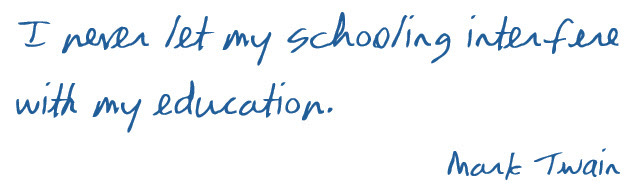
Samuel Clemens, better known as Mark Twain, embodied his own philosophy through an extraordinary life journey. Despite leaving formal schooling at age 12 after his father’s death, Twain became one of America’s most celebrated authors and sharpest social commentators. His education came from working as a riverboat pilot on the Mississippi, traveling the world as a journalist, and observing human nature with keen wit and wisdom.
This quote emerged from Twain’s recognition that his most valuable learning occurred outside classroom walls. His experiences navigating treacherous river currents, witnessing the California Gold Rush, and engaging with diverse cultures provided insights no textbook could offer. Twain understood that formal education, while valuable, can sometimes create rigid thinking patterns that limit creativity and real-world problem-solving. His success stemmed from maintaining childlike curiosity while applying practical wisdom gained through direct experience and continuous learning.
Leadership Principle 1: Lifelong Learning Mindset
The most effective leaders understand that their growth never stops after receiving a diploma or certification. In today’s rapidly evolving business landscape, a marketing executive who earned their MBA fifteen years ago must continuously update their knowledge about digital platforms, consumer behavior, and emerging technologies. Similarly, a manufacturing supervisor who relies solely on traditional methods will struggle when new efficiency protocols or safety standards emerge, while those who embrace ongoing education adapt and thrive.
Leadership Principle 2: Experience-Based Wisdom
True leadership competence develops through applying knowledge in real-world situations, not just theoretical understanding. A project manager who has studied risk management extensively but never navigated an actual crisis lacks the intuitive decision-making skills that come from experience. When that critical moment arrives—perhaps a key vendor fails or a deadline shifts unexpectedly—the leader who has weathered similar storms possesses invaluable practical wisdom that no classroom simulation could provide. This experiential learning creates confidence and adaptability that theoretical knowledge alone cannot match.
Scripture Filter
Proverbs 27:17 declares, “As iron sharpens iron, so one person sharpens another,” while Proverbs 1:5 adds, “Let the wise listen and add to their learning, and let the discerning get guidance.”
These verses beautifully complement Twain’s insight by emphasizing that true wisdom comes through relationship, experience, and humble receptivity to learning from all sources. The Hebrew word for “learning” in these passages implies not just acquiring information, but developing practical skill through application. Scripture consistently portrays the wisest leaders—from Moses learning from his father-in-law Jethro to Paul gleaning insights from diverse cultural encounters—as those who remained teachable throughout their lives. This Biblical perspective validates that formal education represents just the beginning of wisdom, not its culmination. God’s design for growth involves continuous learning through community, experience, and divine guidance.
Experiential Wisdom
I once worked with a brilliant software engineer who held multiple advanced degrees but struggled as a newly promoted team lead. Despite his technical expertise, he couldn’t understand why his team seemed disengaged and deadlines kept slipping. His “schooling” had taught him coding languages and system architecture, but not human motivation or conflict resolution.
Through our coaching relationship, he began his real education. He started having coffee conversations with team members, observing workplace dynamics, and reading about emotional intelligence. He attended leadership workshops, sought mentorship from experienced managers, and practiced new communication skills. His team’s productivity increased dramatically, not because of his technical knowledge, but because he learned to connect with people. His transformation happened when he embraced Twain’s principle: his formal education opened the door, but his willingness to learn from experience, relationships, and even failures created his leadership breakthrough.
Reflection Questions
What assumptions from your formal training might be limiting your growth or problem-solving approaches today?
When was the last time you actively sought learning from someone with different experiences or perspectives than your own?
How might your current challenges be opportunities for education that no classroom could provide?
What would change in your leadership effectiveness if you approached each interaction as a chance to learn something new?
Your Growth Invitation
If Mark Twain’s wisdom resonates with your leadership journey, let’s explore how to accelerate your experiential learning and break through the barriers that formal thinking sometimes creates. I’d love to schedule a complimentary discovery call to discuss your specific growth goals and design a learning path that transforms both your leadership capacity and your results.
Ready to Be Far More! than you ever imagined possible? Let’s schedule that conversation today.