
Attitude Shift
From flat-tire stagnation to unstoppable momentum—discover how mindset recalibration unlocks your team's full potential.

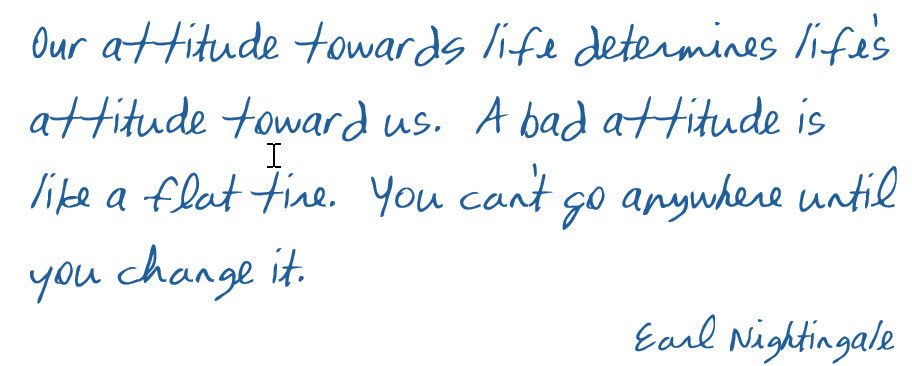
Earl Nightingale, the pioneering voice of personal development, discovered this principle during a pivotal moment in 1950s America when he observed that successful people shared one invisible common denominator: their attitudes. What makes Nightingale’s insight credible isn’t theory — it’s backed by five decades of studying thousands of achievers across industries. The surprising biographical detail? Nightingale began his career as a radio broadcaster during the Depression, witnessing firsthand how some people thrived despite scarcity while others spiraled. That crucible taught him that external circumstances matter far less than internal orientation. His landmark “The Strangest Secret” audio program became the first of its kind to sell over a million copies, proving that attitude fundamentally reshapes destiny.
Triple-Filter Analysis
Knowledge Lens: The Neuroscience of Attitude
Research from Stanford’s Carol Dweck reveals that fixed mindsets (believing abilities are static) activate amygdala threat responses, triggering defensive decision-making in leaders. Conversely, growth-minded leaders show heightened prefrontal cortex activation—the region governing strategic thinking and innovation. Additionally, a Harvard study on decision fatigue found that leaders with negative attitudes toward challenges make 31% more errors in high-pressure decisions than those maintaining solution-focused perspectives.
Consider this workplace reality: Gallup data shows that only 23% of employees actively engage at work, and the #1 driver of disengagement? Their leader’s attitude. When you lead with a flat-tire mindset—believing obstacles are permanent—your team mirrors that lethargy. Conversely, leaders who model attitude-shift resilience see engagement spike to 67%. This isn’t mystical; it’s neurological. Your attitude literally broadcasts either limiting beliefs or possibility-thinking to everyone watching you make decisions.
Historical parallel: When Apollo 13 faced catastrophic systems failure, Mission Control’s attitude—”failure is not an option”—cascaded through every team member, transforming a potential tragedy into humanity’s greatest problem-solving achievement.
Experience Crucible: From Blame-Game to Breakthrough
I coached an operations director who came to me frustrated with his team’s “lack of initiative.” During our first session, he described his team as “unmotivated and defensive.” As we dug deeper using the three filters, an uncomfortable truth surfaced: his attitude toward their potential was the flat tire.
The Struggle: This leader unconsciously communicated skepticism. In team meetings, he’d preview problems before celebrating possibilities. His body language screamed, “I doubt you can handle this.” Naturally, his team internalized that message and stopped volunteering ideas.
The Implementation: We implemented two tactical changes. First, the 24-hour Reframe Practice—before every team interaction, he spent 90 seconds identifying one growth opportunity hidden in the challenge. Second, Possibility Language Protocol: he replaced “That won’t work because…” with “How could we make that work if…?” This shifted his attitude from gatekeeper to catalyst.
The Results: Within six weeks, voluntary problem-submissions increased 240%. Sick days dropped by 18%. Most telling? During a crisis that previously would’ve triggered blame-shifting, the team self-organized and solved it without his intervention. That’s the power of a leader shifting their attitude—the entire ecosystem responds.
Scriptural Anchor: Timeless Wisdom
Old Testament Foundation — Proverbs 23:7 (NIV): “For as a man thinks in his heart, so is he.” Solomon captured the attitudinal principle 3,000 years ago: your internal orientation becomes your external reality. The ancient Hebrew concept of leb (heart/mind) emphasizes that leadership begins with internal alignment.
New Testament Fulfillment — Philippians 4:8 (NIV): “Finally, brothers and sisters, whatever is true, whatever is noble, whatever is right, whatever is pure, whatever is lovely, whatever is admirable—if anything is excellent or praiseworthy—think about such things.” Paul understood that intentional mindset management isn’t positive-thinking fluff; it’s a discipline that rewires neural pathways toward redemptive thinking.
Biblical Deepening: Scripture reveals attitude as stewardship. You’re not just managing your emotions; you’re stewarding influence. When a leader chooses a redemptive attitude toward obstacles, they model to their teams—and ultimately their organizations—that circumstances don’t determine destiny. That’s kingdom leadership.
Leadership Pathway: Lead Yourself → Your Team → Others
Self: The Daily Microhabit
Mindset Reset Moment
Each morning, identify one upcoming challenge and complete this sentence: “This obstacle is an opportunity to demonstrate that I can…” This rewires your reticular activating system to scan for solutions rather than threats. Over 21 days, this recalibrates your default attitude from defensive to exploratory.
Team: The Communication Protocol
Psychological Safety through Attitude Transparency
In your next team meeting, vulnerability-launch with: “Here’s a challenge I’m facing, and here’s my current attitude about it—and why that attitude might be limiting us.” Then ask: “What attitude shift would unlock new possibilities here?” This permission-giving transforms your team’s willingness to bring their full selves and best thinking.
Others: The Influence Strategy
Modeling as Mentorship
When interfacing with stakeholders or peer leaders, narrate your attitude-shift moments: “Initially I thought this was a setback, but I realized my attitude was the real obstacle. Here’s what shifted…” This demonstrates that even seasoned leaders recalibrate. It gives permission throughout your sphere of influence for others to do the same.
Growth Ignition: Three Probing Questions
Exposure Question: “When you face your toughest leadership challenge right now, what attitude are you unconsciously broadcasting to your team about it—and is that attitude serving them?”
Rationalization Detector: “How many times this week have you blamed external factors when your attitude toward those factors was actually the leverage point?”
Barrier Revealer: “What would become possible for your leadership if you genuinely believed obstacles were opportunities disguised as problems?”
15-Second Challenge
Right now—before moving to your next task—identify one person on your team who needs to see you model an attitude shift. Text them this: “I want to shift my approach on [specific situation]. Let’s grab 10 minutes.” That vulnerable initiation rewires your culture’s entire attitude architecture.
Invitation: Your Leadership Leverage Audit
These insights only matter if they activate your specific blind spots. I’m offering a free 30-minute Discovery Audit where we assess which attitude patterns are limiting your leadership leverage. Together, we’ll apply the Knowledge-Experience-Scripture filters to your actual situation and identify your 1° trajectory shift.
Ready to lead yourself, your team, and others toward opportunities you’ve been missing? Let’s talk.